
How to Apply Epoxy Flooring to a Garage (Step-by-Step)

Coating your garage floor with epoxy is one of the most satisfying weekend DIY jobs you can take on. Done properly, it turns a dusty, stained slab into a hard, easy-to-clean surface that shrugs off oil, hot tyres and dropped tools for years. This step-by-step guide walks you through the whole process, from prep to top coat.
Before you start: is your slab ready?
Epoxy only performs as well as the surface underneath it. Your concrete needs to be:
- Cured - at least 28 days old if it is a new pour.
- Dry - no rising damp. Tape a 1m x 1m plastic sheet to the slab overnight; if moisture beads underneath, you have a damp problem to solve first.
- Sound - no flaking, crumbling or loose sections.
Step 1 - Clean and degrease
Sweep, then scrub the whole floor with a concrete degreaser to lift oil and grease, paying extra attention to the area under where the car sits. Rinse and let it dry. Any oil left behind will stop the epoxy bonding.
Step 2 - Etch or grind the surface
Bare concrete is too smooth and too alkaline for epoxy to grip. Acid etching with our concrete etch opens up the surface to a texture like fine sandpaper. Work in sections, scrub it in, then rinse thoroughly and let the slab dry completely. (Mechanical grinding is the professional alternative if you have the gear.)
Step 3 - Repair cracks and divots
Fill any cracks, holes or pitting with a concrete repair filler and let it cure. A smooth, sound surface now means a smooth finish later.
Step 4 - Prime
A primer coat seals the concrete, blocks air bubbles rising out of the slab, and dramatically improves how the colour coat bonds and spreads. Cut in the edges with a brush, then roll the rest. Let it cure as directed before recoating.
Step 5 - Apply the epoxy colour coat
This is the main event. Mix Part A and Part B thoroughly in the right ratio - under-mixed epoxy will not cure. Once mixed you are on the clock (the "pot life"), so work steadily:
- Cut in the edges of the garage with a brush.
- Roll the epoxy onto the floor in 1-2m square sections, keeping a wet edge.
- If you are using decorative flakes, broadcast them onto the wet epoxy as you go, throwing up and out so they land flat.
- Work back towards your exit so you do not paint yourself into a corner.
Step 6 - Apply the clear top coat
Once the colour coat has cured, a clear top coat seals in any flakes and adds the final layer of durability and gloss. For flake floors you may lightly scrape and vacuum loose flakes first. Add an anti-slip additive to the top coat if the floor will get wet.
Step 7 - Cure before use
Resist the urge to park on it straight away. As a rule of thumb you can walk on it after about 48 hours and return your car after about 7 days, depending on temperature. See our guide on epoxy cure times for the full breakdown.
Tools you will need
A stiff broom, scrubbing brush, rollers and a roller frame with an extension pole, cutting-in brush, mixing paddle, gloves and spiked shoes if you are broadcasting flakes. Our epoxy application kit packs the essentials together.
Ready to get started? Browse our garage floor epoxy kits - flake and plain colour systems with everything you need to coat your garage in a weekend.
Related guides
Keep reading

Bunnings Garage Floor Epoxy Compared: What You Get, and What’s Missing
Short answer: Bunnings sells several garage floor coatings from about $120 to $380, and two of them (Rust-Oleum...
Read guide
Is DIY Epoxy Flooring Worth It? DIY Kit vs Pro (Australia)
A DIY epoxy kit costs around $499-$729 delivered and a professional install runs $2,000-$4,500 - so DIY saves...
Read guide
Garage Floor Paint vs Epoxy: Which Coating Actually Lasts?
Garage floor paint is a single-part product that dries into a thin film sitting on top of the...
Read guide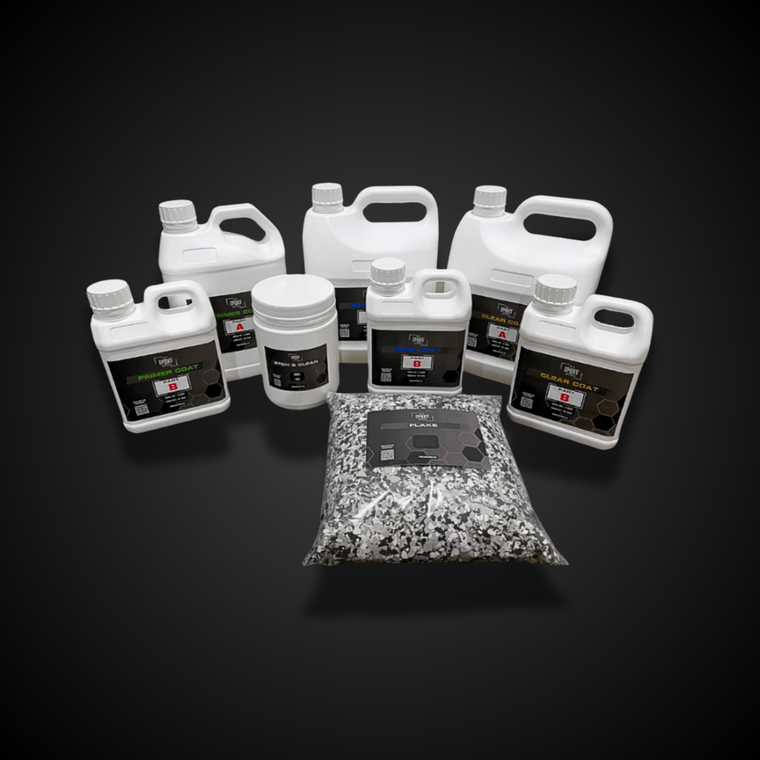
DIY Epoxy Flake Floor Kit – Garage & Concrete Coating
Everything in one box - etch, prime, colour, flake and clear - matched to your garage, with a step-by-step guide and real phone support.